



Integrative Psychotherapy Articles
 German
 English
 Spanish
 French
 Italian
 Portuguese
 Russian
Core Concepts of an
Integrative Transactional Analysis
Marye O'Reilly-Knapp and Richard G. Erskine
Abstract
In integrative transactional analysis, the conceptual constructs, theories, and sub theories are organized into a theory of motivation, a theory of personality, and a theory of methods. The theory of motivation examines human functioning and the need for stimuli, structure, and relationship. The theory of personality describes internal and external contact, interruptions to contact, life script, and ego function. The theory of methods emphasizes the power of a healing relationship. These theories and methods assist clinicians in understanding human beings, in normalizing the functions of psychological processes, and in healing through relationship.
______
This article was written in collaboration with Vincent Barrone, Fred Clark, Joan D'Amico, Landy Gobes, Burkhard Hofman, Fred Hufford, Joan Lourie, Carol Merle- Fishman, Linda Perrin, Elizabeth Richards, Damon-Arthur Wadsworth, Martha Walrath, and Joshua Zavin.
Core Concepts of an Integrative
Transactional Analysis
Eric Berne's writings over a 15-year period outlined what he considered the important concepts in transactional analysis theory. He had many brilliant ideas that had a remarkable influence on both the general practice of psychotherapy and the culture as a whole. His ideas and terminology regarding strokes, games, script, ego states, and contracts are now part of the common lexicon and are echoed both in popular publications and in the general psychotherapy literature.
Writings by Berne (1957/1977, 1961, 1972) on the concept of ego states give specific definitions and descriptions of “archaic Child ego states” (Berne, 1961, pp. 226-227) and the intrapsychic effects of an “influencing Parent ego state” (Berne, 1972, p. 444). These writings focus on the intrapsychic dynamics of ego states. Later, in seminar discussions, Berne shifted to behavioral and transactional descriptions of ego states. Yet he recognized that his theoretical work on ego states, and specifically the development of clinical methods for working with both archaic regression and intrapsychic influence of Parent ego states, was incomplete (Berne, 1961). He left it for future generations of transactional analysts to challenge, refine, and further develop transactional analysis theory and clinical practice (Berne, 1972).
Berne identified and even developed many of the early core concepts in transactional analysis, but he did not expand on or refine many other concepts, subtheories, or treatment interventions. He also wrote very little on clinical methods. Berne (1966) cited eight therapeutic operations that were psychoanalytic in origin, and he provided some rudimentary examples of his therapeutic exchanges with clients (Berne, 1961). He actively encouraged others to write about their clinical experience, to develop theory, and to refine the core concepts of transactional analysis. In fact, the Eric Berne Memorial Scientific Award and the Eric Berne Memorial Award were created for that very purpose: to encourage the development and refinement of transactional analysis theory and methods. Since 1972, the articles for which these awards were given have expanded the core concepts of transactional analysis and enriched both the theory and clinical practice.
Berne either did not realize how profound some of his ideas were, or he simply did not develop some concepts. For example, the concept of stimulus or sensation, recognition, and structure hungers (Berne, 1961) could have provided a metatheory—that is, a transactional analysis theory of motivation. However, Berne (1966) merely simplified it into a taxonomy of time structure, and his original glimpses into the significance of “hungers” as a system of motivation were thus lost. Consequently, transactional analysis theory has, until recently, lacked an adequate explanation of motivation (Erskine, 1995/1997d).
Toward the end of his life, Berne (1972) wrote a book on scripts that was actually published posthumously: What Do You Say After You Say Hello?: The Psychology of Human Destiny. In it he primarily examined the child hood origin of such unconscious life plans. He was interested in how the life script (formed by parental programming, injunctions, modeling, fairy tales, and decisions in childhood) influenced later adult behavior and current important relationships, determined the nature of fantasies and selected memories, and affected general health in adult life. However, other than providing cognitive awareness, Berne did not describe therapeutic methods for the treatment of these unconscious, destructive beliefs, feelings, and behavioral patterns as manifested in the adult client.
Over the last 25 years, a long series of articles have defined an integrative transactional analysis. Beginning in 1975 with “The ABC's of Effective Psychotherapy,” Erskine (1975/ 1997a) identified how transactional analysis could be integrative of the client's personality when addressing the cognitive, affective, and behavioral domains during psychotherapy. Afective, cognitive, behavioral, and physiological domains represent examples of where the client is open or closed to contact, and they provide the clinician with an awareness of avenues for therapeutic direction. This integrative concept was also central in “The Racket System: A Model for Racket Analysis” (Erskine & Zalcman, 1979) and “Script Cure: Behavioral, Intrapsychic, and Physiological” (Erskine, 1980/ 1997b). Ware (1983) and Joines (1986) expanded the concept of identifying where clients are open or closed to contact and applied it to standard diagnostic categories. In addition, Cornell (1975, 1997) espoused the importance of integrating touch and neo-Reichian body therapies with transactional analysis.
Recent writings in integrative transactional analysis have focused on principles of psycho therapeutic practice and a theory of motivation (Erskine, Moursund, & Trautmann, 1999). The transactional analysts who are writing and practicing from an integrative perspective have based their theoretical foundations solidly on Eric Berne's concepts and have also turned to other theories and writers for challenge, validation, and cross-fertilization of ideas (Bary & Hufford, 1990; Christoph-Lemke, 1999; Clark, 2001; Gobes, 1990; Guistolise, 1996; Korol, 1998; Little, 1999; Loria, 1991; Lourie, 1996; Matze, 1991; O'Reilly-Knapp, 2001a, 2001b; Putnam, 1996; Salinger, 1996; Small, 1996; Spitz, 1996).
Integrative Concepts
Several theoretical models illustrate the fundamental concepts of integrative psychotherapy. The conceptual constructs, theories, sub theories, and interrelated ideas are organized into three classes of theory: motivation, personality, and methods. A theory of motivation pro vides both a comprehensive understanding of human functioning and a metaperspective that encompasses and unifies the theories of personality and methods. The biological imperatives of stimulus hunger, structure hunger, and relationship hunger provide such a theory of human motivation.
Classical transactional analysis writings have not emphasized a theory of motivation that ex plains human functioning while providing an organizing frame for understanding both theories of personality and methods. Steiner's (1974) writings on strokes and English's (1977, 1987, 1988) writings on “existential patterns” that emanate from survival, expressive, and quiescence drives are early attempts to provide a transactional analysis theory of motivation.
Four visual models illustrate the theories of personality in an integrative transactional analysis. The concepts of internal and external contact and interruptions to contact are represented in the self-in-relationship model (Figure 1). This model identifies the cognitive, affective, behavioral, and physiological domains as well as the interpersonal space of contact with others. It provides an avenue for therapeutic direction (Erskine & Trautmann, 1993/1997b).

Figure 1
The Self-in-Relationship System
The model of the script system (Figure 2) and Berne's (1961) original model of ego states illustrate the core concepts of life script and ego function. Each of these models is a clinical tool that can be used to identify both behavioral manifestations and intrapsychic processes of contact disruption, life script, or ego state conflicts. The conceptual model of ego states (Figure 3) illustrates the dynamics of a Parent ego state's internal influence on a dependent Child ego state fixated in a previous develop mental period of time. The script system further elaborates on the intrapsychic components of an archaic system of survival reactions, conclusions, and decisions that are designed to repress archaic needs and feelings. The behavioral display, internal physiological experiences, fantasies, and reinforcing memories confirm the script beliefs and maintain interruptions to contact (Erskine & Zalcman, 1979).
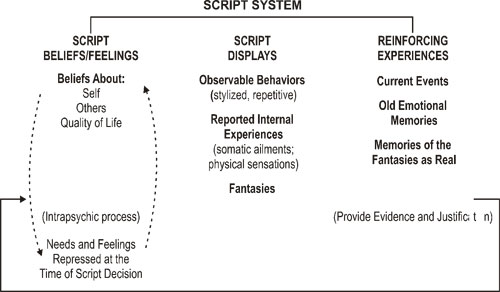
Figure 2
The Script System
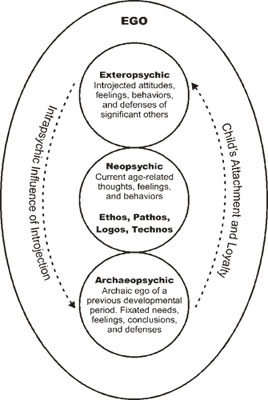
Figure 3
States of the Ego
The theory of methods is based on the premise that script cure occurs in the contactful, healing relationship between client and therapist. The “Keyhole” (Figure 4) is a visual diagram of the theory of methods. This theory and mod el emphasizes contact with self (an intrapsychic process) and external contact-in-relationship (an interpersonal process). Inquiry, attunement, and involvement are categories of many therapeutic transactions and comprise “sets of con tact-facilitating, relationship-oriented methods” (Erskine & Trautmann, 1996/1997a, p. 22). The concepts of inquiry, attunement, and involvement represent an array of methods that are central to the therapeutic relationship and crucial for reorganization of personality that leads to script cure.
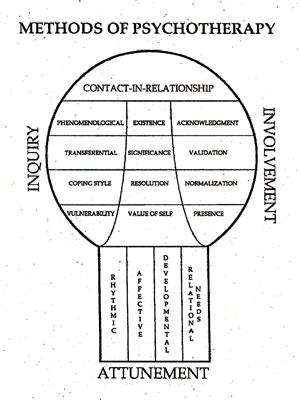
Figure 4
Methods of an Integrative Psychotherapy
Integrative transactional analysis thus has a coherent theory of motivation, personality, and methods that provides theoretical consistency and unifies the link between motivation and personality and also gives direction to therapeutic methods.
Fundamental Principles
The central philosophical orientation—the fundamental principles—of integrative psycho therapy include:
- Acknowledging that people are relation ship seeking and interdependent through out life
- Affirming the innate value of human beings
- Normalizing the functions of psychological processes
- Committing to positive life change
- Focusing on internal and external contact as essential to human functioning
- Emphasizing the developmental process of the individual
- Recognizing the significance of the therapeutic relationship
These principles guide integrative transactional analysts in their therapeutic methods by pro viding a value system about therapeutic process and, especially, the relationship of the client with the therapist.
Motivation, Contact, and Relationship
Acknowledging that people are relationship seeking gives meaning to a theory of motivation that describes the human being's need for stimuli, structure, and relationship. Berne (1963) wrote: “A striving for intimacy under lies the most intense and important operations” (p. 159). Integrative psychotherapy has integrated Berne's concepts of the hungers within a contact-and-relationship framework. Attention is given to the biological imperatives of stimulus, structure, and relationship hungers as a theory of motivation.
Stimulus: “Stimuli operate both internally and externally and provide the information al feedback system that leads to the satisfaction of basic needs” (Erskine, 1995/ 1997d, p. 12).
Structure: “Structure hunger is the drive to organize experience . . . [an] innate drive to form perceptual patterns and configurations . . . that create meaning and predictability and . . . organize the continuity of experience over time” (Erskine, 1995/ 1997d, p. 12).
Relationship: “Satisfaction of relation ship hunger depends on the awareness of relational needs (internal stimulus), what the individual believes about self and others in the interpersonal relationships (structure), and the behavior of the other person in the relationship (external stimulus)” (Erskine, 1995/1997d, p. 13).
All three hungers are important since disruption in any one may cause overcompensation in at least one of the others. For example, a person who does not have a meaningful relationship may use overstructure to compensate for the lack of relationship. Berne (1961) wrote that “stimuli are necessary in order to assure the integrity of the neopsyche and the archeopsyche. If the flow [of stimuli] is cut off or flattened into monotony, it is observed that the neopsyche becomes disorganized . . . and finally archeopsyche function becomes disorganized as well” (p. 83).
Contact is also an important part of a theory of motivation. Focusing on internal and external contact is viewed as essential to human functioning. Internal contact consists of “sensations, emotions, ideas, fantasies, wants, and needs” (Erskine, Moursund, & Trautmann, 1999, p. 4). Relationship with others is also an important component of motivational theory. One of the major premises of integrative psychotherapy is that the need for relationship is “a primary motivating experience of human behavior, and contact is the means by which the [relational] need is met” (Erskine & Trautmann, 1996/1997a, p. 20). Contact with self (all of our sensations, feelings, memories, thoughts, wants, needs, desires, fantasies) and with others (our relationships) are affected by how open or closed we are to contact. Defensive protections keep us closed off to contact; dissolving of the defenses opens us to contact. The therapeutic relationship then provides both an opportunity for dissolving the defensive positions built on archaic beliefs and decisions and a focus on living in the now by achieving satisfaction of today's relational needs with family and friends.
Relational needs are included in the theory of motivation. “Relational needs are the needs unique to interpersonal contact” (Erskine & Trautmann, 1996/1997a, p. 28). These relational needs are considered in two domains: the here and now and the archaic ego. When life experiences have been integrated (Adult ego state), then relational needs are based on the here-and-now relationship. In contamination of the Adult ego through either archaic fixations (Child ego states) or introjections (Parent ego states), present adult needs are compromised. In the therapeutic relationship, unintegrated Parent and Child fragments are addressed through an understanding of how the archaic needs—needs unrequited in early relationships —are enacted in the transference. Relational needs—that is, needs important throughout the life cycle—include: the need for security, where protection is experienced in the relation ship; validation, affirmation, and significance within relationship; acceptance by a stable and dependable other person; confirmation of one's personal experience by the other; self-definition, where one's uniqueness can be expressed and accepted by another; the need to impact another; the need to have the other initiate; and the need to express love (pp. 28-31).
Personality Organization
Ego states, transference, and the script system are the principle concepts identified within a theory of personality in integrative transactional analysis. The archaic Child ego states and the introjected Parent ego states are viewed as separate states of the ego that have not become integrated through life experiences. Defensive mechanisms stabilize and protect the individual, but this stability restricts the spontaneity, intimacy, and flexibility so essential for growth.
Knowledge of ego defense mechanisms is integral to understanding ego state functioning and how ego states are activated. It is because of the fixation of defense mechanisms that the archaic (Child) or introjected (Parent) aspects of ego remain separate states and do not become integrated into neopsychic (Adult) awareness. (Erskine & Moursund, 1988, p. 23)
These developmental fixations are analyzed by taking into consideration “a four-part correlation of the behavioral, social, historical, and phenomenological determinants of ego states” (Erskine, 1991/1997e, p. 136).
Transferential transactions are identified within the perspective of ego states as a manifestation of either an archeopsychic or exteropsychic ego state where there is an intrapsychic conflict between two or more of the ego states (Erskine, 1991/1997e, p. 139). Transference is viewed as:
- The means whereby the client can de scribe his or her past, the developmental needs that have been thwarted, and the defenses that were erected to compensate;
- The resistance to full remembering and, paradoxically, an unaware enactment of childhood experiences [the repeated relationship];
- The expression of an intrapsychic conflict and the desire to achieve [the satisfaction of relationship needs and] intimacy in relationships [the therapeutically needed relationship]; or
- The expression of the universal psychological striving to organize experience and create meaning. (p. 143)
The script system reflects the script-driven responses and the patterns of transferential transactions that emerge in the therapeutic relationship. Working with script within the script system allows the therapist to focus on three dimensions: behavioral, intrapsychic (affective and cognitive), and physiological. The focus is always on where the person is open or closed to contact. The script system addresses the intra psychic beliefs and feelings, behaviors, fantasies, memories, and physiological experiences.
The script system . . . provides a model for understanding the systematic dynamics among the intrapsychic, behavioral, and physiological dimensions of life script. The script system diagrams how the intra psychic reactions (defensive conclusions and decisions) and introjections that form the core of the life script are organized as script beliefs; how these core beliefs are manifested in behavior, fantasy, and physiological tensions; and how an individual structures his or her perceptions and interpretations of experience to provide the reinforcement of script beliefs. (Erskine, 1994/1997c, p. 57)
The reorganization of personality occurs in the integration of affective, cognitive, and physiological intrapsychic processes with manifested behavior through a contactful, therapeutic relationship.
Inquiry, Attunement, and Involvement
The processes of inquiry, attunement, and involvement are categories of specific methods. Each of these categories are “sets of contact- facilitating and relationship-oriented methods” (Erskine & Trautmann, 1996/1997a, p. 22).
Inquiry: “The process of inquiry involves the therapist being open to discovering the client's perspective while the client simultaneously discovers his or her sense of self with each of the therapist's awareness- enhancing statements or questions.” (p. 22)
Attunement: “Attunement is a two-part process: It begins with empathy—that is, being sensitive to and identifying with the other's sensations, needs, or feelings—and the communication of the sensitivity to the other person.” (p. 24)
Involvement: “Therapeutic involvement that includes acknowledgment, validation, normalization, and presence diminishes internal defensive processes.” (Erskine & Trautmann, 1996/1997a, p. 31)
Inquiry, attunement, and involvement are central to the theory of methods and provide a framework for conceptualizing the principle methods of integrative psychotherapy. The theory of methods affirms the innate value of human beings and recognizes the significance of the therapeutic relationship.
The goal of an integrative transactional analysis is for the client, in the relationship with the therapist, to discover and understand intrapsychic processes and defensive mechanisms. Empathic therapeutic inquiry, attunement, and involvement allow the client to enact the psychic process and its defenses in the therapeutic relationship. The intrapsychic functions of predict ability, identity, consistency, and stability are considered in helping the client move out of old defenses and distortions. The therapeutic relationship is used as the “between” space, that is, between the old protective patterns and a new way of relating (Erskine, Moursund, & Trautmann, 1999, p. 239).
Sensitivity to the client's developmental level of psychological functioning is an important part of the methodology. Attunement to the developmental level means being aware of and responsive to the client's behaviors and experiences at the level of regression. “The purpose of the developmental focus is to respond to the client at the age level at which there was a lack of contact-in-relationship, when fixations occurred in the representational system of self, others, and the quality of life” (p. 27). The age of the client's experiences is considered in order to acknowledge, validate, and normalize these experiences. “Through an inquiry into the history, expectations, coping, choices, decisions, and vulnerabilities, phenomenological, transferential, and defensive levels of experience may come to the foreground” (Erskine & Trautmann, 1996/1997a, p. 23). The unrequited needs of childhood fixated in figure or ground, and the defenses enacted as compensation become the focus of psychotherapy.
As the client experiences acknowledgment and validation in the therapeutic relationship, what was not given to that person in the early experience may come to the foreground. The relationship with the therapist triggers an awareness of the lack of relationship in the original trauma or neglect. The juxtaposition reaction is described as intense emotional responses sparked by the therapist's contact with the client (Erskine & Trautmann, 1996/1997a, p. 33). The phenomenon of juxtaposition “occurs when there is, for the client, a marked contrast between what is provided in the therapeutic relationship and what was needed and longed for but not provided in previous relationships” (Erskine, Moursund, & Trautmann, 1999, pp. 151-152). A conflict is created out of the need for contact and the realization of the missing relationship. Understanding the phenomenon of juxtaposition may assist the therapist in identifying interruptions in contact and the client in understanding what was needed.
Disruptions in contact also occur in the ruptures or interruptions of the therapeutic relationship. Examining the ruptures or interruptions may provide client and therapist with in formation and understanding about archaic failures and remnants that affect relationships today. Repair in the therapeutic relationship provides for the exploration of the relationship failure in the now and, ultimately, for a better understanding of the repetitive, archaic failures (Erskine, 1994/1997c).
Another avenue to cognitive, affective, behavioral, and physiological awareness is in a supportive regression. Within such a regression, the client, in the presence of the therapist, can explore his or her original fixations and introjections. In this process, “a client can re examine relationships, access and change old decisions, and heal the cumulative trauma of childhood through enacting and experiencing in fantasy what was not available in reality” (Erskine, Moursund, & Trautmann, 1999, p. 63). The purpose of the regression is to identify conflicts in earlier developmental levels, to provide an opportunity to explore historical and phenomenological experiences, and to identify what patterns continue in present relationships.
Confrontation is a specific method used to bring into awareness a discrepancy between contradictory thoughts and behaviors. In this particular process, the focus is on the client's defensive position and the implications of this defensiveness for present-day relationships (O'Reilly-Knapp, 2001a, 2001b). For the client to face such defenses and the purpose of such protections, a strong therapeutic relationship is crucial. Also important is an empathic confrontation that takes into account respect for and sensitivity to the client's position. An integrative transactional analysis article by Clark (1991) proposed empathic transactions in “regulating the intensity and directness of trans actions during different phases of treatment” (p. 92). In an established therapeutic relation ship, confrontation can be very useful.
Another method that warrants attention is free association. Free association is similar to the psychoanalytic method in that the client is invited to say whatever comes into his or her mind. The one exception is that free association within integrative transactional analysis involves the therapist in relationship with the client. This is done by having the therapist as a witness to the client's free associations and as an active partner in selectively expressing what he or she thinks and feels. The therapist's presence allows for underscoring, elaborating, and clarifying, all of which leads to inquiring and validating and thus acknowledging the significance of the client's experience.
The last component to be included is body work, a major dimension of script cure. The treatment goal in body script work “is to energize the body tissue that was inhibited and rigidified in the repression of the unmet needs and primal feelings” (Erskine, 1980/1997b, p. 154). Physiological reactions can be observed, such as in tightening of the body musculature and changes in breathing patterns. Internal experiences that are not readily observable can be accessed by inquiring into the person's phenomenological experience. Working directly with body structures may include touch, muscle massage, altering breathing patterns, and encouraging and/or inhibiting movements (Erskine, 1980/1997b). The physiological domain must be aligned with the other three domains —the cognitive, affective, and behavioral. When integrated, these dimensions of human functioning help the person to live more fully in the present.
Conclusion
Berne gave transactional analysts a strong foundation on which to build and to develop further his ideas. Integrative transactional analysis has taken Berne's ideas on hungers and developed a theory of motivation—the biological imperatives of stimulus hunger, structure hunger, and relationship hunger. Ego states and intrapsychic processes, life script, and contact and interruptions to contact are central to a theory of personality. The processes of inquiry, attunement, and involvement are categories of specific methods that are contact facilitating and relationship oriented. The categories of methods are manifestations of the theory of methods: healing is in the contactful, therapeutic relationship.
The theory of motivation, theory of personality, and theory of methods are represented by four models. The model for the theory of motivation is represented by the dynamic balance of the biological imperatives of stimulus, structure, and relationship hungers. The model of personality is represented in the self-in-relationship diagram, Berne's conceptual ego state model, and the script system. The “Keyhole” —which represents the interplay of inquiry, attunement, and involvement—is a schematic of the theory of methods. Congruence and unity between the integrative transactional analysis theories of motivation, personality, and methods assist the psychotherapist in understanding human beings, in normalizing the functions of their psychological processes, and in healing through relationships.
Just as Berne criticized the theory and methods of Freudian psychoanalysis, he also challenged those with whom he worked to refine and add to the theory and methods of transactional analysis. We, in following Berne's style of criticism and challenge, invite others to refine and add to the theory of transactional analysis. The task for all of us, no matter what school we identify with—the San Francisco school of transactional analysis, redecision therapy, the Cathexis school of transactional analysis, or integrative transactional analysis— is to help our clients reach an optimal level of well-being. As our clients achieve script cure and grow to understand and appreciate their own uniqueness, may we, too, continue to develop and refine our theories and methods.
Richard G. Erskine, Ph.D., TSTA, is Training Director of the Institute for Integrative Psychotherapy, New York.
Marye O'Reilly-Knapp, D.N.Sc., CTA, is in private practice in Devon, Pennsylvania, and also is an assistant professor at Widener University School of Nursing.
The collaborators on this article are all members of the Professional Development Seminar of the Institute for Integrative Psycho therapy, Kent, Connecticut, U.S.A.
Please send reprint requests to Richard G. Erskine, Ph.D., 500 E. 85th St., New York, NY 10028, U.S.A.
REFERENCES
Bary, B. B., & Hufford, F. M. (1990). The six advantages to games and their use in treatment. Transactional Analysis Journal, 20, 214-220.
Berne, E. (1961). Transactional analysis in psycho therapy: A systematic individual and social psychiatry. New York: Grove Press.
Berne, E. (1963). The structure and dynamics of organizations and groups. New York: Grove Press.
Berne, E. (1966). Principles of group treatment. New York: Grove Press.
Berne, E. (1972). What do you say after you say hello?: The psychology of human destiny. New York: Grove Press.
Berne, E. (1977). Ego states in psychotherapy. In E. Berne, Intuition and ego states: The origins of transactional analysis (P. McCormick, Ed.) (pp. 121-144). San Francisco: TA Press. (Original work published 1957)
Christoph-Lemke, C. (1999). The contributions of transactional analysis to integrative psychotherapy. Transactional Analysis Journal, 29, 198-214.
Clark, B. D. (1991). Empathic transactions in the deconfusion of child ego states. Transactional Analysis Journal, 21, 92-98.
Clark, F. (2001). Psychotherapy as a mourning process. Transactional Analysis Journal, 31, 156-160.
Cornell, W. (1975). Wake up “sleepy”: Reichian techniques and script intervention. Transactional Analysis Journal, 5, 144-147.
Cornell, W. (1997). Touch and boundaries in transactional analysis: Ethical and transferential considerations. Transactional Analysis Journal, 27, 30-37.
English, F. (1977). What shall I do tomorrow? Reconceptualizing transactional analysis. In G. Barnes (Ed.), Transactional analysis after Berne: Teachings and practices of three TA schools (pp. 287-347). New York: Harper's College Press.
English, F. (1987). Power, mental energy, and inertia. Transactional Analysis Journal, 17, 91-98.
English, F. (1988). Whither scripts? Transactional Analysis Journal, 18, 294-303.
Erskine, R. G. (1997a). The ABC's of effective psycho therapy. In R. G. Erskine, Theories and methods of an integrative transactional analysis: A volume of selected articles (pp. 227-288). San Francisco: TA Press. (Original work published 1975)
Erskine, R. G. (1997b). Script cure: Behavioral, intra psychic, and physiological. In R. G. Erskine, Theories and methods of an integrative transactional analysis: A volume of selected articles (pp. 151-155). San Francisco: TA Press. (Original work published 1980)
Erskine, R. G. (1997c). Shame and self-righteousness: Transactional analysis perspectives and clinical interventions. In R. G. Erskine, Theories and methods of an integrative transactional analysis: A volume of selected articles (pp. 46-67). San Francisco: TA Press. (Original work published 1994)
Erskine, R. G. (1997d). The therapeutic relationship: Integrating motivation and personality theories. In R. G. Erskine, Theories and methods of an integrative transactional analysis: A volume of selected articles (pp. 7- 19). San Francisco: TA Press. (Original work published 1995).
Erskine, R. G. (1997e). Transference and transactions: A critique from an intrapsychic and integrative perspective. In R. G. Erskine, Theories and methods of an integrative transactional analysis: A volume of selected articles (pp. 128-146). San Francisco: TA Press. (Original work published 1991)
Erskine, R. G., & Moursund, J. P. (1988). Integrative psychotherapy in action. Newbury Park, CA: Sage Publications.
Erskine, R. G., Moursund, J. P., & Trautmann, R. L. (1999). Beyond empathy: A theory of contact-in- relationship. Philadelphia: Brunner/Mazel.
Erskine, R. G., & Trautmann, R. L. (1997a). Methods of an integrative psychotherapy. In R. G. Erskine, Theories and methods of an integrative transactional analysis: A volume of selected articles (pp. 20-36). San Francisco: TA Press. (Original work published 1996)
Erskine, R. G., & Trautmann, R. L. (1997b). The process of integrative psychotherapy. In R. G. Erskine, Theories and methods of an integrative transactional analysis: A volume of selected articles (pp. 79-95). San Francisco: TA Press. (Original work published 1993)
Erskine, R. G., & Zalcman, M. J. (1979). The racket system: A model for racket analysis. Transactional Analysis Journal, 9, 51-59.
Gobes, L. (1990). Ego states—Metaphor or reality? Transactional Analysis Journal, 20, 163-165.
Guistolise, P. G. (1996). Failures in the therapeutic relationship: Inevitable and necessary? Transactional Analysis Journal, 26, 264-288.
Joines, V. (1986). Using redecision therapy with different personality adaptations. Transactional Analysis Journal, 16, 152-160.
Korol, J. A. (1998). Confluence, isolation, and contact in psychotherapy with clients who dissociate. Transactional Analysis Journal, 28, 111-120.
Little, R. (1999). The shame loop: A method of working with couples. Transactional Analysis Journal, 29, 141- 148.
Loria, B. R. (1991). Integrative family therapy: A constructivist perspective. In B. R. Loria (Ed.), The Stanford papers: Selections from the 29th ITAA conference (pp. 35-41). Madison, WI: Omnipress.
Lourie, J. (1996). Cumulative trauma: The nonproblem problem. Transactional Analysis Journal, 26, 276-283.
Matze, M. G. (1991). Commentary on transactions in the context of transference. Transactional Analysis Journal, 21, 141-143.
O'Reilly-Knapp, M. (2001a). Between two worlds: The encapsulated self. Transactional Analysis Journal, 31, 44-54.
O'Reilly-Knapp, M. (2001b). Therapeutic love, intellectual truth, and theoretical understandings: A clinical application of the theory and methods of integrative psychotherapy. Transactional Analysis Journal, 31, 274-282.
Putnam, J. (1996). Reflections of a integrative psycho therapist. Transactional Analysis Journal, 26, 289-292.
Salinger, R. A. (1996). Therapeutic involvement: The bull becomes attuned. Transactional Analysis Journal, 26, 203-302.
Small, L. (1996). A brief sketch by an integrative psycho therapist. Transactional Analysis Journal, 26, 303-306.
Spitz, S. (1996). An integrative approach to psycho therapy: A case study. Transactional Analysis Journal, 26, 307-311.
Steiner, C. (1974). Scripts people live: Transactional analysis of life scripts. New York: Grove Press.
Ware, P. (1983). Personality adaptations: Doors to therapy. Transactional Analysis Journal, 13, 11-19.
This article was first published in the Transactional Analysis Journal, Vol. 33, No. 2, pp. 168-177. Reprinted with permission of the ITAA